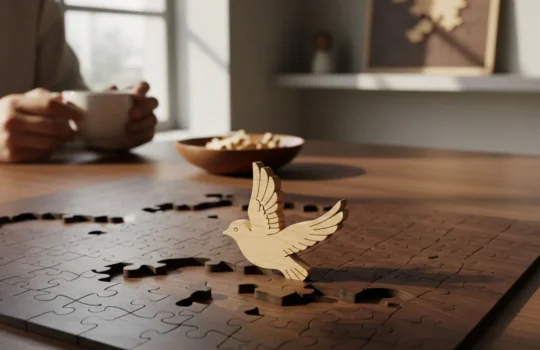
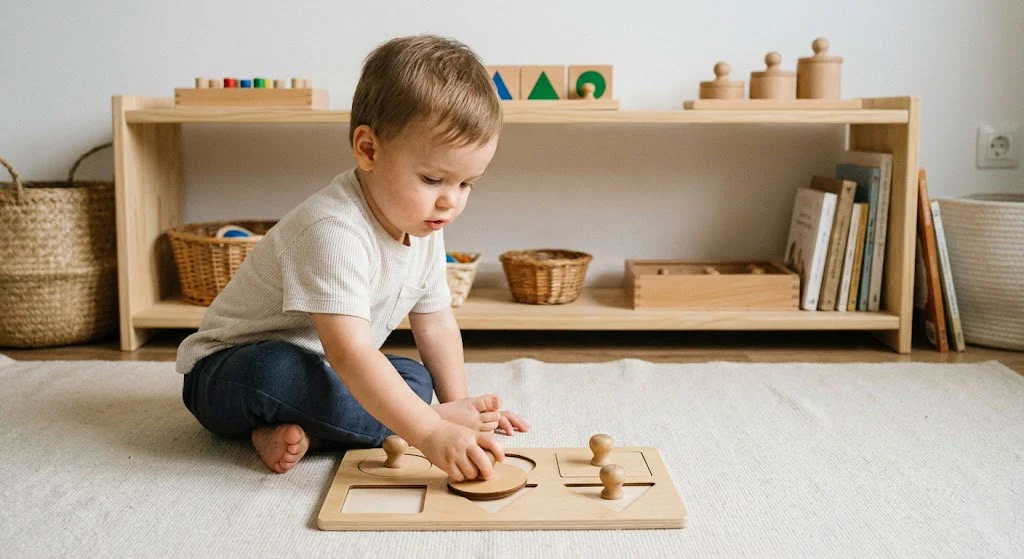
If you walk into a modern playroom today, you are likely to be greeted by a symphony of beeps, flashing lights, and singing plastic animals. While these toys might capture a child’s attention for a fleeting moment, they often do the playing for the child, rather than encouraging the child to play. In contrast, step into a Montessori classroom, and you will notice a distinct difference. The atmosphere is calm. The materials are natural. And almost always, you will find a child sitting quietly on a rug, deeply engrossed in solving a wooden puzzle.
For decades, the Montessori method has championed the humble wooden puzzle not just as a toy, but as a fundamental learning tool. But why? What makes a simple piece of wood superior to a high-tech gadget? In this guide, we will explore the Montessori approach to early learning and why incorporating wooden puzzles into your child’s playtime is one of the best investments you can make for their development.
1. The Power of “Control of Error”
One of the most brilliant concepts in Montessori philosophy is the “Control of Error.” This refers to materials that allow a child to correct their own mistakes without needing an adult to intervene. Think about a standard electronic toy. If a child presses the wrong button, the toy might buzz or say, “Try again!” The feedback comes from the machine. The child looks to the toy for validation.
Now, consider a wooden puzzle. If a child tries to force a square piece into a circular hole, it simply won’t fit. The feedback is mechanical and instant. The material itself tells the child, “This isn’t quite right, try another way.”
Why does this matter?
-
Independence: The child realizes they can solve the problem on their own. They don’t need to look at Mom or Dad and ask, “Is this right?”
-
Self-Correction: It encourages the child to analyze the shape, rotate the piece, and try again. This process builds resilience and critical thinking skills.
-
Confidence: The satisfaction of that final “click” when the piece fits perfectly comes from their own effort, building genuine self-esteem.
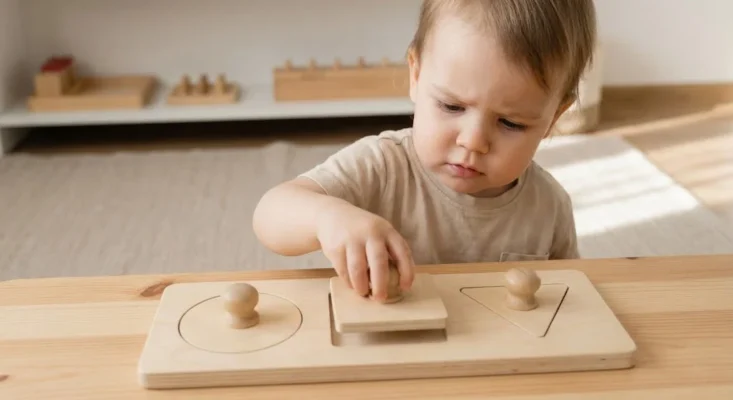
2. Developing Fine Motor Skills & Pre-Writing Muscles
You might just see a toddler playing, but a Montessori guide sees a child preparing to write. Wooden puzzles, especially those designed for toddlers (often called Knob Puzzles), are engineered to strengthen the hand muscles. When a child grabs a large puzzle piece with their whole hand, they are using a Palmar Grasp. As they grow and graduate to puzzles with small wooden pegs, they must use their thumb and pointer finger to pick up the piece. This is known as the Pincer Grasp.
The Connection to Writing: The Pincer Grasp is the exact same muscle movement required to hold a pencil, a crayon, or a paintbrush later in life. By manipulating puzzle pieces, rotating them, and carefully lowering them into place, your child is engaging in a rigorous “workout” for their hands.
Furthermore, this activity refines Hand-Eye Coordination. The eyes see the empty space, the brain processes the shape, and the hand executes the movement. This complex neural loop is strengthened with every single puzzle piece placed.
3. The Sensory Experience: Why Wood Beats Plastic
In our digital age, children are often overstimulated. Flashing lights and loud sounds can trigger a release of dopamine, but they can also lead to fragmented attention spans.
Wooden puzzles offer a grounding sensory experience.
-
Weight & Substance: Wooden pieces have “heft.” They feel solid in a child’s hand. This provides proprioceptive feedback—helping the child understand the weight and presence of objects in space. Plastic pieces are often light, hollow, and flimsy.
-
Texture & Temperature: Wood warms to the touch and has a natural grain texture. It connects the child to the natural world.
-
Quiet Focus: Without batteries or speakers, a wooden puzzle allows the child to focus entirely on the task at hand. The only sound is the satisfying clack of wood on wood.
This lack of artificial distraction is crucial for developing what Maria Montessori called “concentration.” A child engaged with a wooden puzzle is often found in a state of flow, completely absorbed in their work.
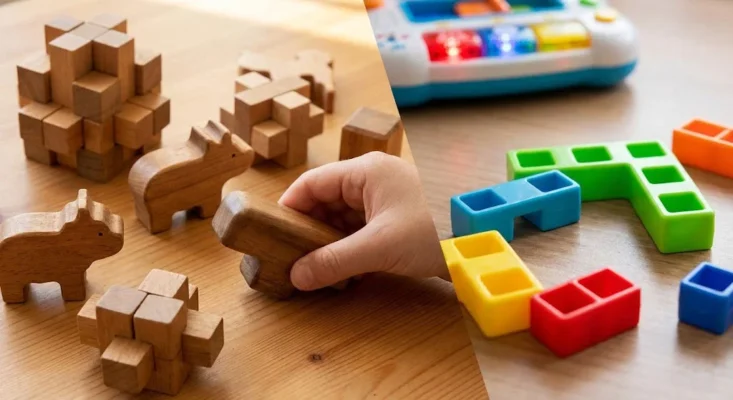
4. Teaching Order and Sequence
Toddlers have a strong, innate sense of order. They feel safe when they know where things belong. Puzzles are the ultimate satisfaction of this need—every piece has one, and only one, perfect home.
Solving a puzzle teaches a child sequencing and logic:
-
I see the whole picture.
-
I see the empty space.
-
I must find the specific part that fills that space.
For older toddlers (3+), Jigsaw Puzzles introduce even more complex logic. They learn to sort by color (finding all the blue sky pieces) or by geometry (finding the edge pieces with straight lines). These are foundational mathematical concepts being learned through play.
5. A Guide to Choosing the Right Puzzle by Age
Not all puzzles are created equal. In the Montessori approach, we introduce puzzles based on the child’s developmental readiness. Giving a child a puzzle that is too hard causes frustration; giving one that is too easy causes boredom.
Here is a quick guide to help you choose:
Phase 1: The Intro (6–12 Months)
Start with Single Shape Puzzles. This is usually a wooden base with just one circle piece and a large knob.
-
The Goal: Exploring cause and effect. Taking the piece out and putting it back in.
Phase 2: The Explorer (12–18 Months)
Move to Multiple Shape Puzzles (Circle, Square, Triangle) with large knobs.
-
The Goal: Recognizing basic geometric shapes and refining the Palmar grasp.
Phase 3: The Refiner (18–30 Months)
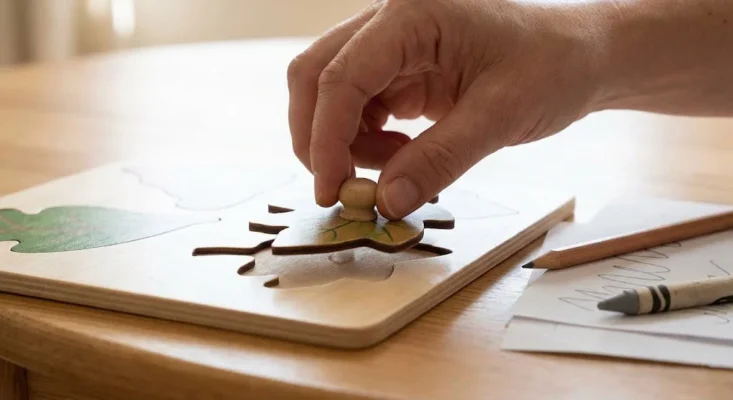
Introduce Realistic Image Puzzles with smaller pegs. Montessori prefers realistic images (a real-looking dog, cat, or car) over cartoonish caricatures, as toddlers are still learning to understand the real world.
-
The Goal: Refining the Pincer grasp and vocabulary building (naming the animals/objects).
Phase 4: The Solver (3+ Years)
This is the time for Jigsaw Puzzles and Sequencing Puzzles.
-
The Goal: Logic, patience, and recognizing patterns. Personalized name puzzles are also fantastic at this stage to help children recognize the letters of their own names.
6. Sustainability and The Heirloom Factor
Finally, let’s talk about the practical side of parenting. Plastic toys often break, crack, or lose their appeal within a few months, eventually ending up in a landfill.
High-quality wooden puzzles are heirloom toys. They are durable, easy to clean, and timeless. A well-made wooden puzzle can be passed down from sibling to sibling, and eventually to the next generation.
Choosing wood is also an eco-conscious decision. By opting for sustainably sourced timber and non-toxic, water-based paints, you are ensuring that your child’s play environment is free from harmful chemicals often found in cheap plastics (like BPA or phthalates). It is safer for your child (who will inevitably put a puzzle piece in their mouth) and safer for the planet.
7. Conclusion
In a world that is constantly trying to sell us “smart” toys with screens and batteries, it turns out that the smartest toy is often the simplest one. Wooden puzzles are more than just a way to pass the time on a rainy afternoon. They are essential developmental tools that foster independence, refine motor skills, and teach children the joy of solving problems on their own. By bringing the Montessori approach into your home with wooden puzzles, you aren’t just giving your child a toy; you are giving them the skills they need to navigate the world with confidence.